GitHub Actions|Deploy Free App Review Monitoring Bot in 3 Steps
Developers seeking real-time app review tracking can deploy a free, secure, and stable monitoring bot using GitHub Actions and ZReviewTender in just three easy steps, ensuring immediate response to user feedback.
This post was translated with AI assistance — let me know if anything sounds off!
Table of Contents
[Quick Start!] Github Action x ZReviewTender Free and Fast Deployment of Your App Store Review Monitoring Bot
Three Simple Steps to Create a Free, Stable, and Secure App Review Bot to Instantly Monitor Users’ Latest Reviews.
{:target="_blank"}](/assets/0095528cf875/1*k8RswW3es9L19jIgbRDLpQ.webp)
ZReviewTender
ZReviewTender — is an open-source App store review bot I created in August 2022. It automatically fetches user reviews from the iOS App Store and Android Google Play stores and forwards them to a designated Slack channel.
You can also specify review fetching rules, integrate with Google Translate, Asana, Google Sheets, and support custom operations.
Github Action
Github Action is a CI/CD automation tool provided by Github. We can use our own machines as servers (Github Runner) or directly use machines provided by Github to run CI/CD and automation scripts.
Costs and Limitations
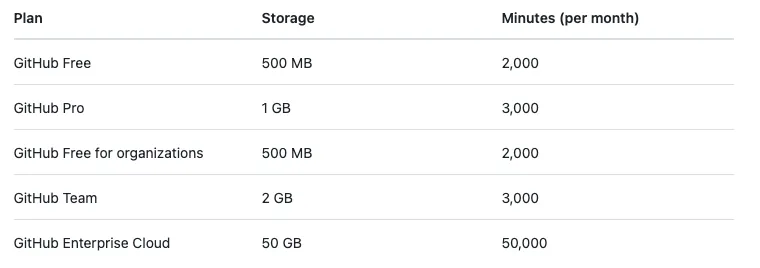
GitHub Free provides basic 500 MB Storage (for CI/CD Artifacts) and 2,000 minutes of execution time per month.
Note here is due to machine cost issues:
If using Github’s Windows machines, the consumed minutes equal the actual minutes multiplied by 2.
If you use Github’s macOS machines, the consumed minutes equal the actual minutes multiplied by 10.
For detailed pricing calculations, please refer to the official pricing calculator.
ZReviewTender Approximate monthly usage: 120 minutes
Only needs to run on basic priced Linux, each execution takes ≤ 1 minute, default runs every 6 hours, spending 4 minutes per day, about 120 minutes per month, well within the free tier.
ZReviewTender _Storage usage: 0*
No use of Artifact to store data, so there is no Storage cost.
Slack
The company’s internal communication software will create a Slack App and use this Slack App identity to forward App Store review notifications to a specified channel.
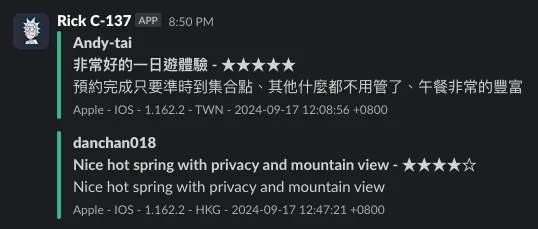
ZReviewTender x Github Action x Slack
We use Github Action to run the ZReviewTender script and forward results to Slack. The Github Repo (Action) is only used as a carrier, so even if your main project is not hosted on Github, you can still easily deploy ZReviewTender by following the steps below. 🎉🎉🎉
I have successfully deployed it on different Apps from 5 different companies, running stably and free of charge for over 2 years.
Advantages:
Free: ZReviewTender is a free and open-source service I created, deployed on Github Action using the free tier, which is more than sufficient.
You don’t need to pay monthly fees for App Review Bot or similar review monitoring services.Security: The credentials and keys used to fetch reviews are securely stored in your Github Private Repo, and only you have access.
You no longer need to risk leaking important credentials or keys by uploading them to third-party services; ZReviewTender is open-source, and all operations are open to public review.Reliable: ZReviewTender uses the latest official APIs to fetch review data. Compared to other services using RSS feeds, it is more accurate, stable, and reliable.
Buy me coffee ❤️❤️❤️

</contact>{:target=”_blank”}
If this project has helped you, please consider buying me a coffee. Thank you.
Quick Start!🚀
The entire setup takes about 30 minutes but only needs to be done once. Unless the credential keys are changed, it can run permanently for free and stably. 🚀🚀🚀🚀🚀
Step 1. Create a Slack App
If your organization already has a Slack App with message-sending permissions like chat:write, you can reuse it directly without creating a new one.
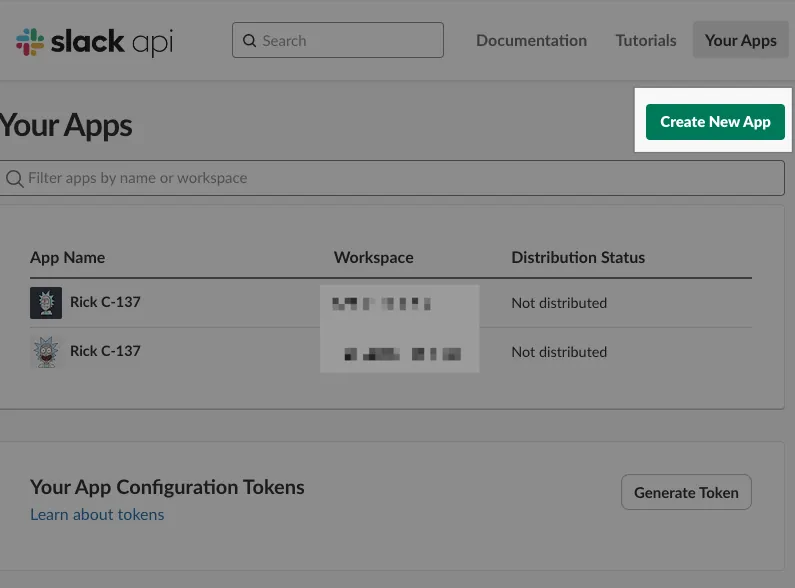
Click the “Create New App” button at the top right corner.
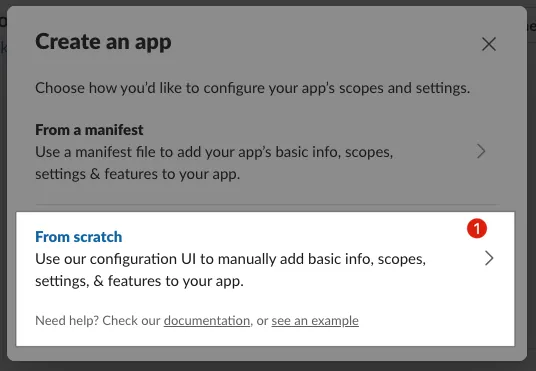
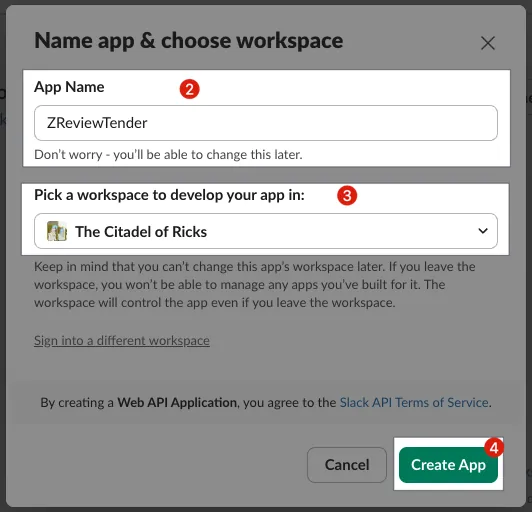
Choose: From scratch
Enter App Name:
ZReviewTenderor a custom Slack App nameSelect the target Slack Workspace for installation: Please make sure you have permission to add a Slack App to the Workspace you choose.
Create App
Add OAuth & Permissions Scopes:
After creating the Slack app, go to the “OAuth & Permissions” tab to set the Scopes.
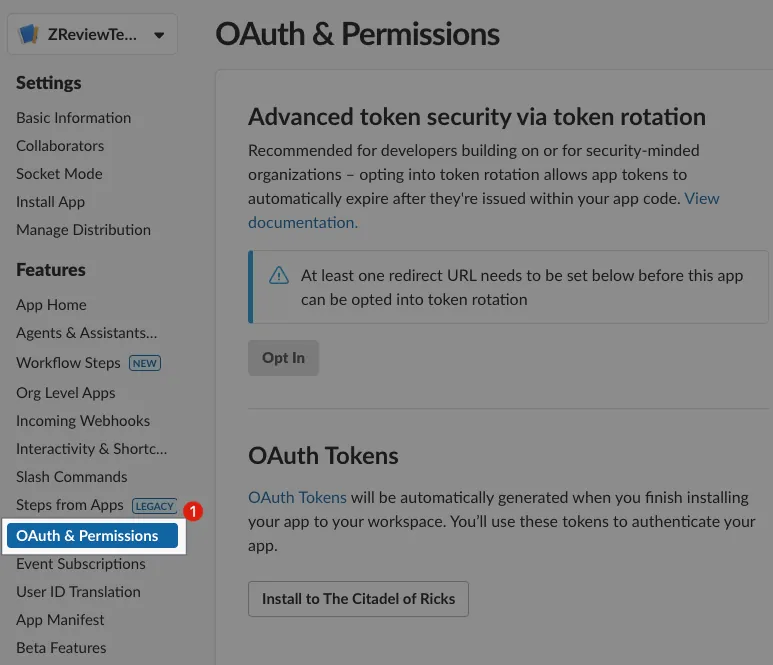
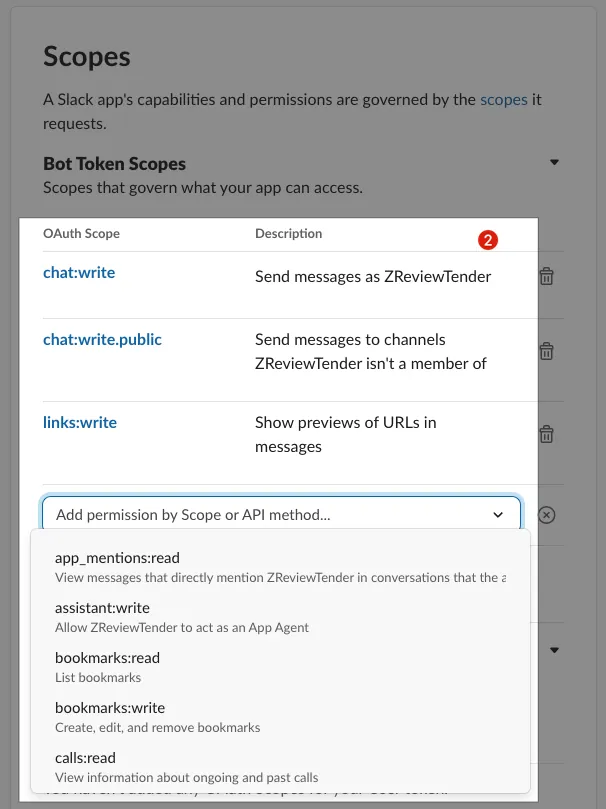
Select “OAuth & Permissions”
Scroll down to find the Scopes Section
Enter the three required scopes for adding the ZReviewTender Slack App in order:
chat:write
chat:write.public
links:write
Install App
Go back to the Install App tab to install the Slack App into your Workspace.
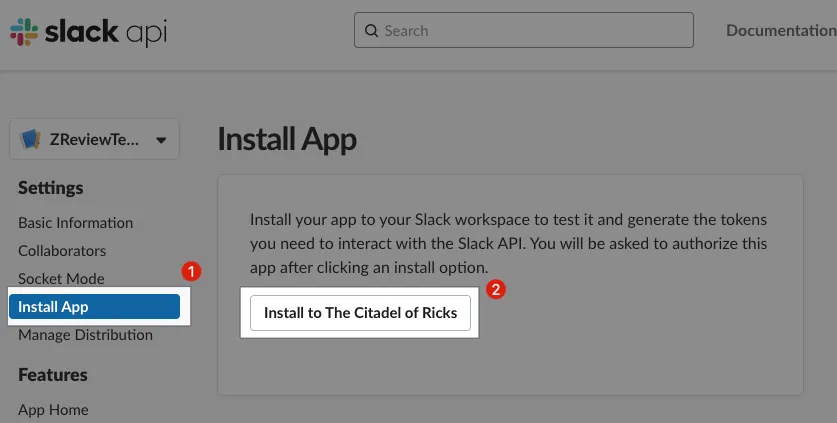
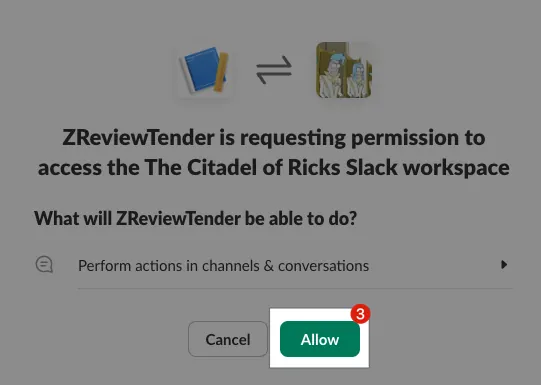
Select “Install App”
Click “Install to YOUR_WORKSPACE”
Click “Allow”
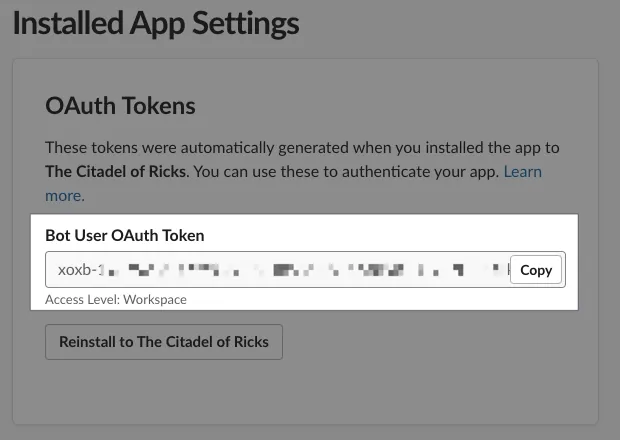
After installation, return to the Install App page where the Slack App Bot User OAuth Token will appear. Click “Copy” to copy it, make sure to save it for later use.
Create a Channel to Receive Review Notifications:
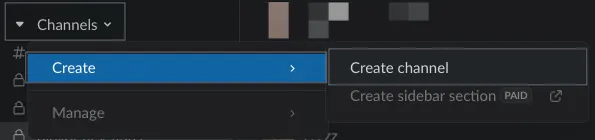
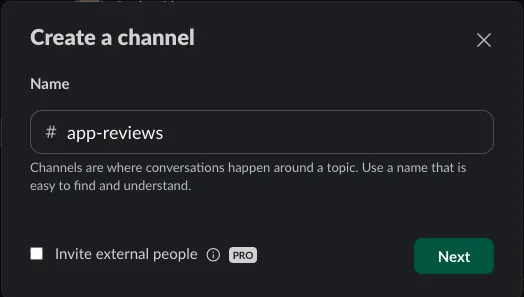
Sidebar -> Channels -> Create -> Create channel
Name: Enter the desired channel name
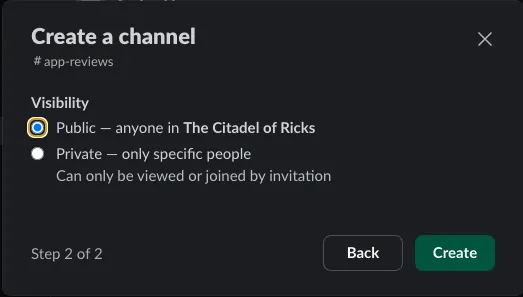
Visibility:
Public: Open to everyone, no further action required.
Private: Private channel, ⭐️⭐️⭐️ You need to add the newly created Slack App:
How to Add Slack App to a Channel:
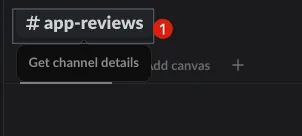
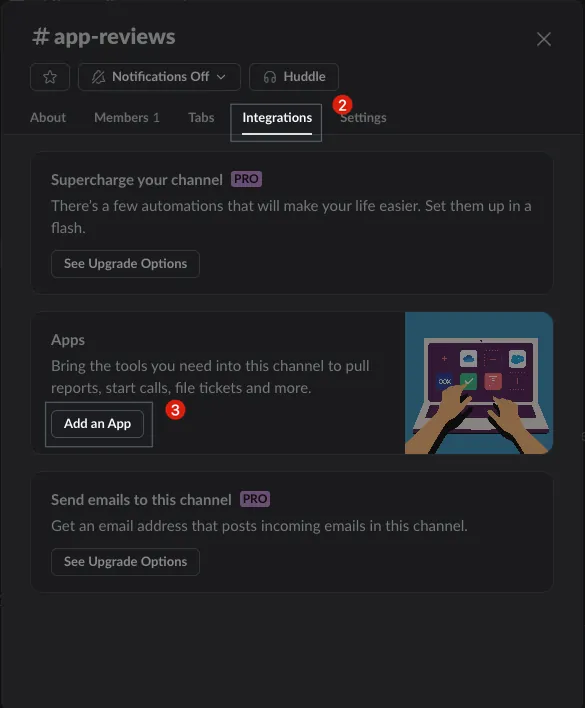
Click the #channel name above
Click “Settings”
Click “Add an App”
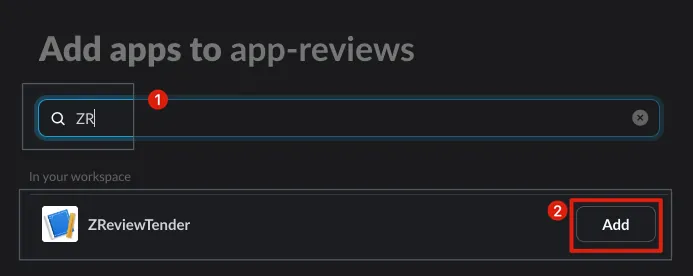
Search for the Slack App name you just created
Click “Add”

A prompt message will appear upon successfully joining the channel: ZReviewTender joined.
⭐️⭐️⭐️There is a Slack bug here: a newly created Slack App may not be found immediately and might take some time to appear; you can use a Public Channel first, as Public Channels can be used without adding the Slack App.
Get Channel ID:
The final and most important step is to obtain the Channel ID for later configuration.
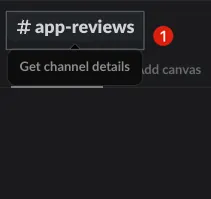
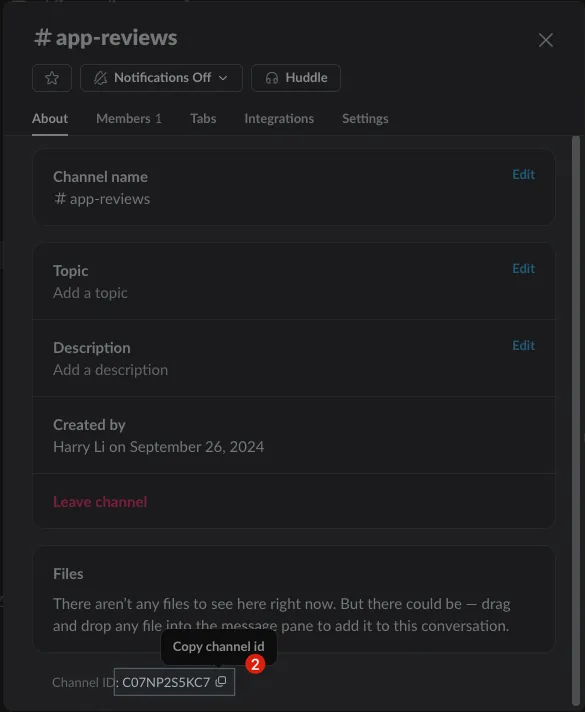
Click the #channel name above
At the bottom, there is Channel ID information.
Note down the
Channel IDfor later configuration
Slack steps completed.
— — —
Other Notes:
You can edit the Slack App name and icon in “Basic Information” -> “Display Information”:
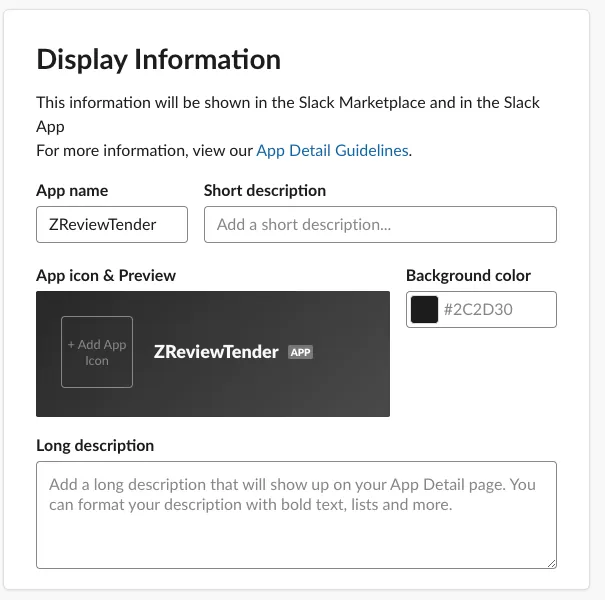
Remember to click “Save Changes” at the bottom right to save your modifications.
If OAuth & Permissions Scopes are updated, you need to click “reinstall your app” to apply the changes:
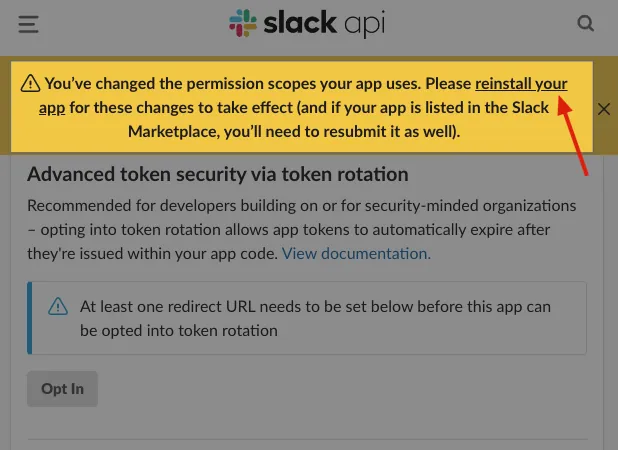
Step 2. Generate Apple App Store Connect API & Google Play Android Developer API Credentials
Apple App Store Connect API Credentials
iOS is easier; we only need to get the following four pieces of information from App Store Connect:
Issuer ID:
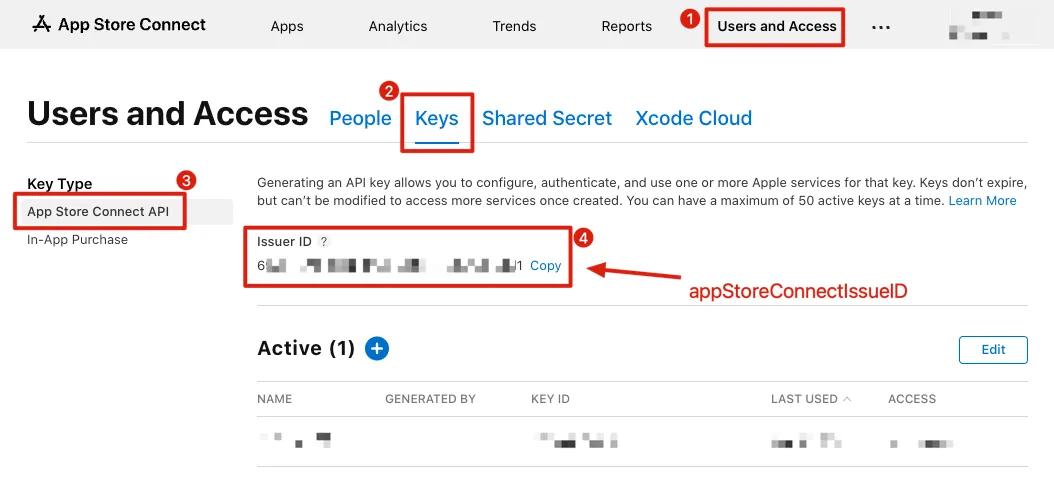
App Store Connect -> Keys -> App Store Connect API
Note down the
Issuer IDfor later configuration
Private Key ID & Private Key:
Click the “+” Add Button:
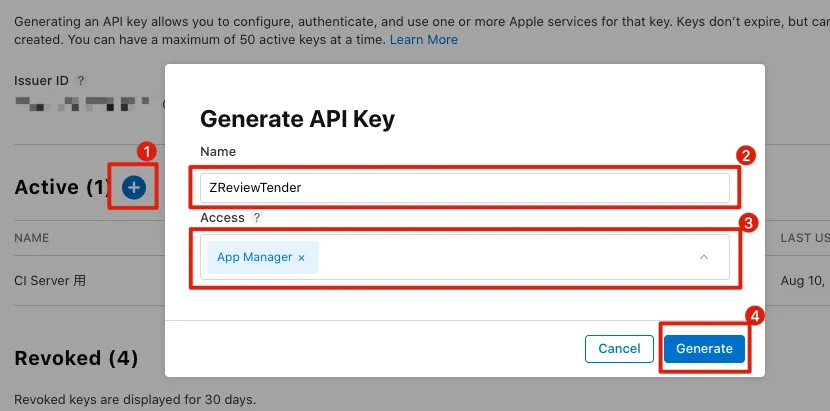
Name:
ZReviewTenderAccess:
App Manager
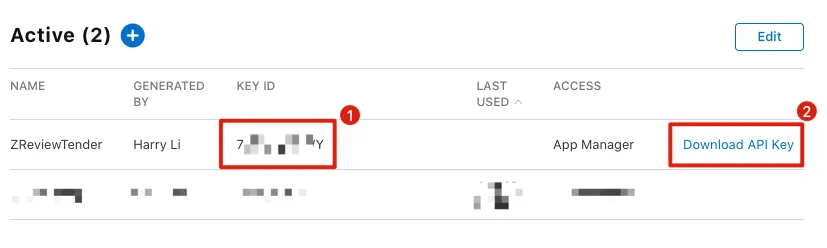
Key ID, to be used later for configurationClick “Download API Key” to save the downloaded
AuthKey_XXXXXXXXXX.p8file for later configuration.
App ID : (The target App ID to fetch reviews)
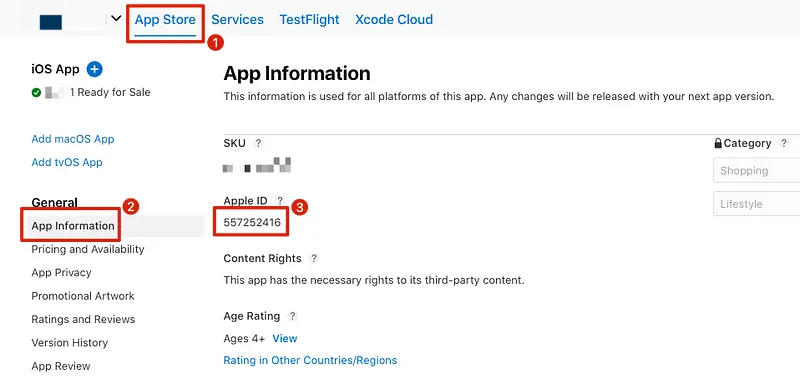
The App ID can be found in App Store Connect -> App Store -> General -> App Information -> App ID.
- Note down the
App IDfor later configuration
Google Play Android Developer API Credentials
Android is more complex. You need to first enable the API in the Google Cloud Project associated with the app, create a Service Account, and add the Service Account to the Google Play Console with app permissions.
Select the Google Cloud Project associated with your App project or create a new Project.
Enable “Android Developer API”:
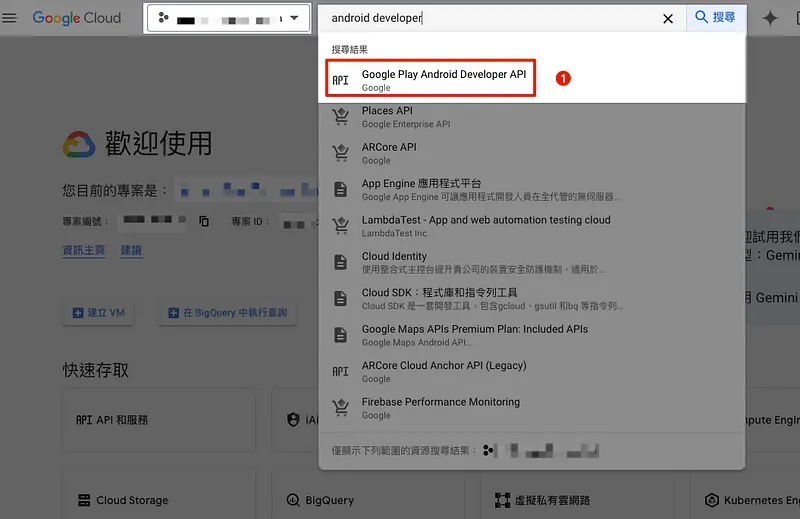
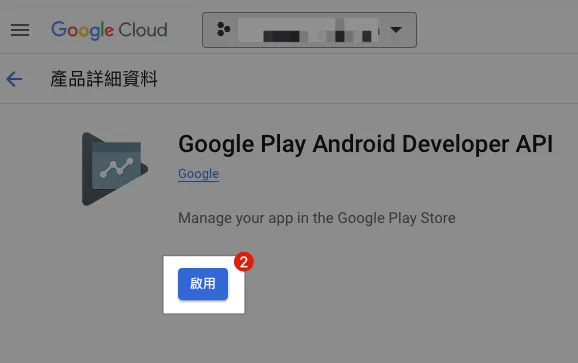
Search for “Android Developer API” and click to enter
Select “Enable”
[Optional Step] You can also enable the “Cloud Translation API”:
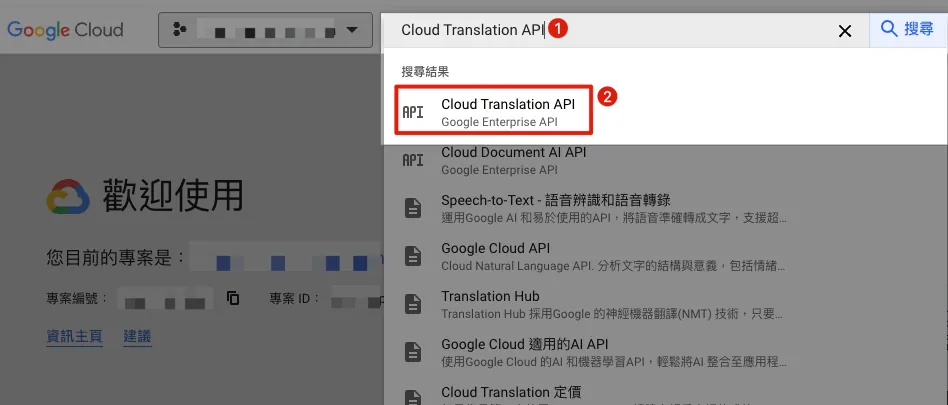
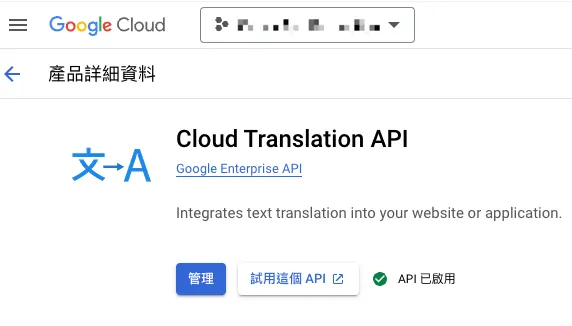
After enabling, you can use the same Service Account credentials to connect the automatic review translation feature.
Note: The Cloud Translation API is not free; language detection and translation will incur charges!
Note: The Cloud Translation API is not free; language detection and translation will incur charges!
Note: The Cloud Translation API is not free; language detection and translation will incur charges!
Create Service Account:
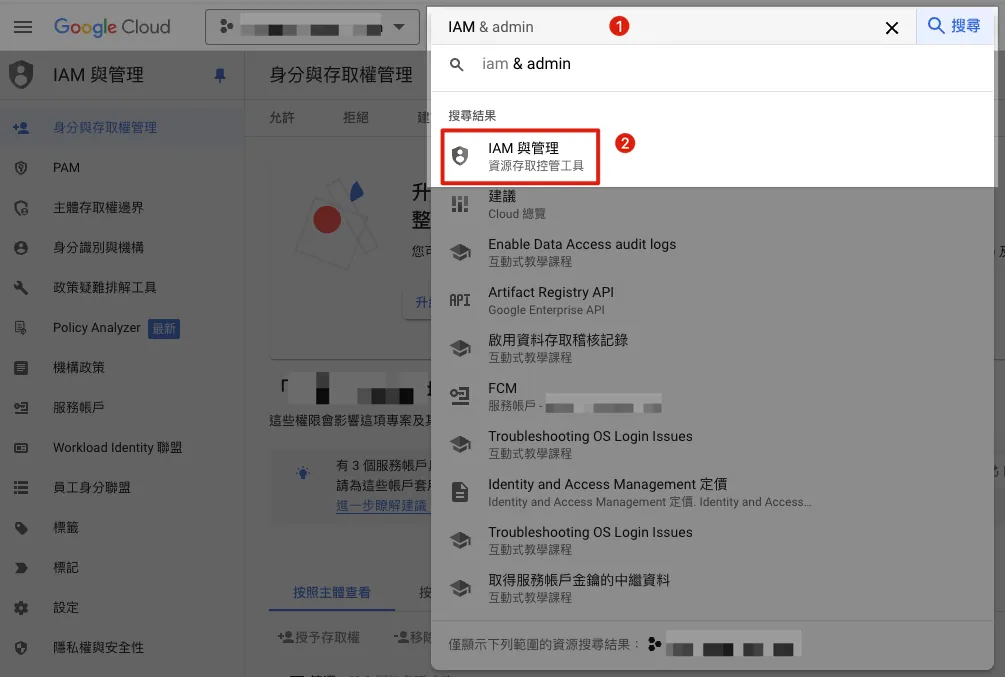
Search for “IAM”
Select “IAM & Admin”
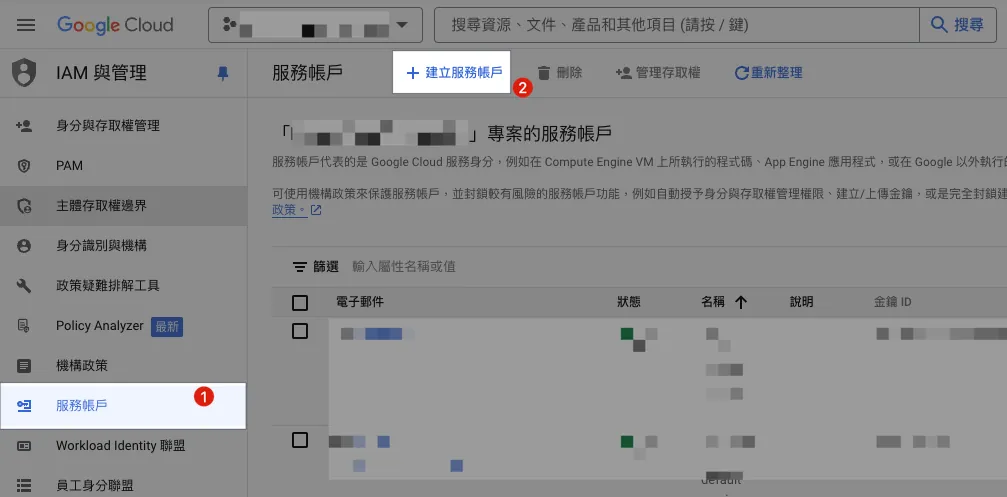
Select “Service Account”
Select “Create Service Account”
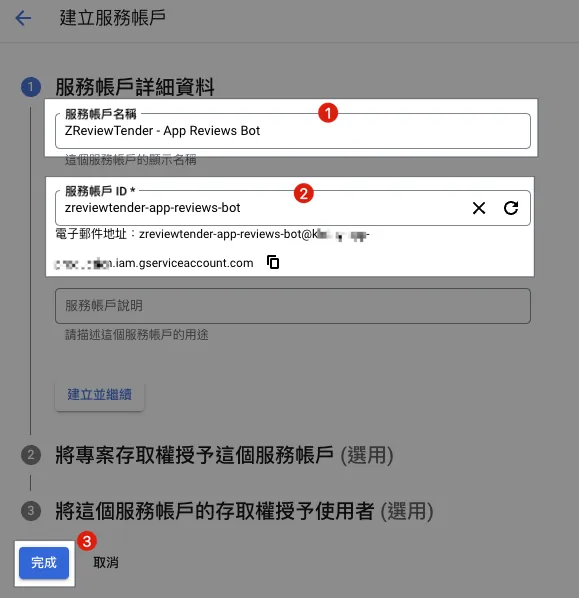
Service Account Name: Enter your own name, such as
ZReviewTenderorGoogle Play Review BotService Account ID: Automatically filled in; no need to change unless special requirements. This will also be your Service Account Email.
Click “Done”
Note down the email address of this Service Account:

The list page will also display the Service Account Email address
Note down the
Service Account Emailfor later configuration
Create Service Account Key Credentials:
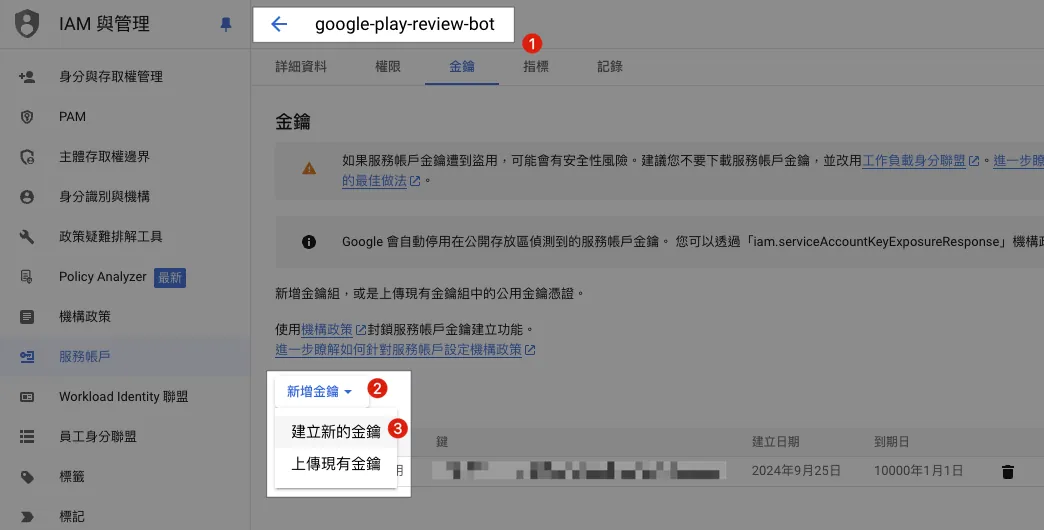
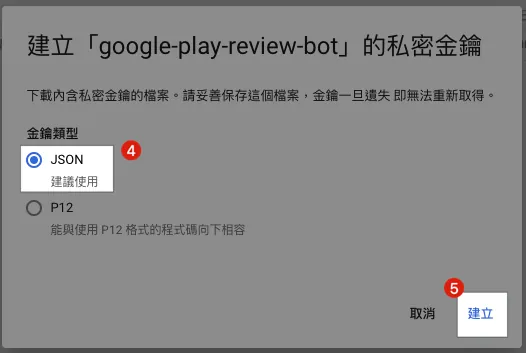
Refresh the list page, then click to enter the newly created Service Account.
Click “Add Key”
Click “Create a new key”
Select the key type as “JSON”
Click “Create”
Save the downloaded
XXXX-XXXX.jsonfile for later configuration
Add the service account to Google Play Console and grant permissions to the target app for fetching reviews:
Enter the Google Play Console backend:
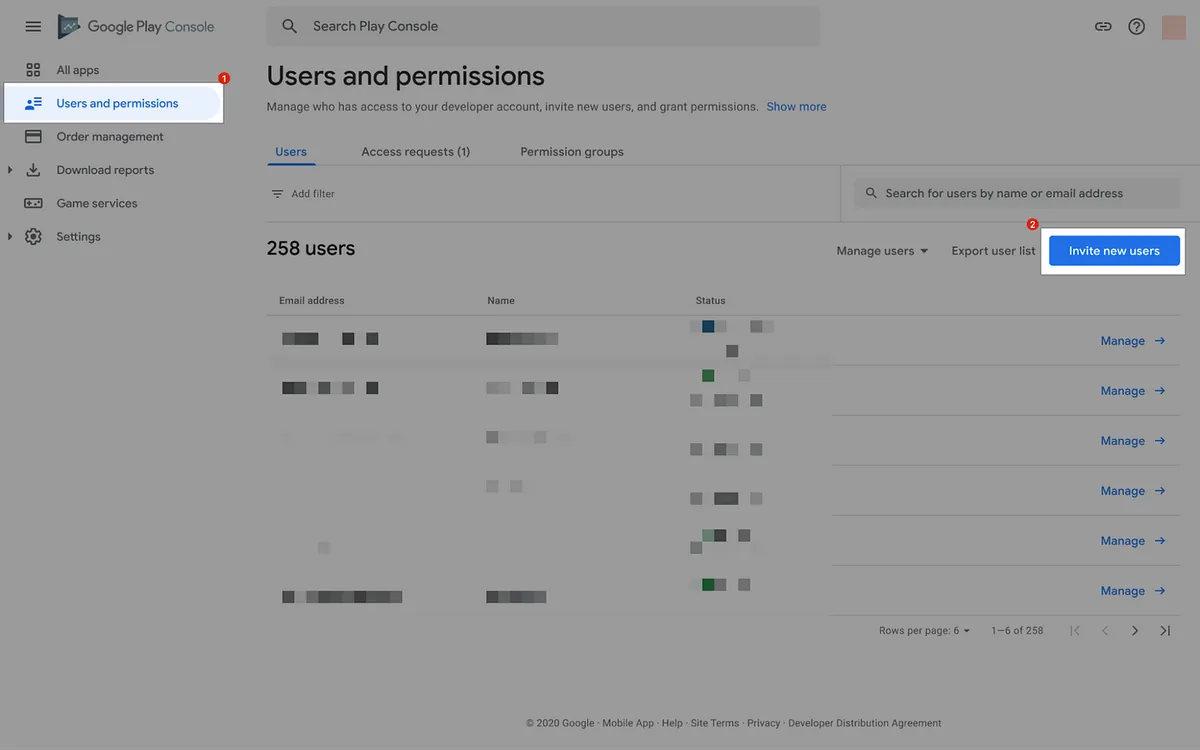
Click “Users and permissions”
Click “Invite new users” on the right side
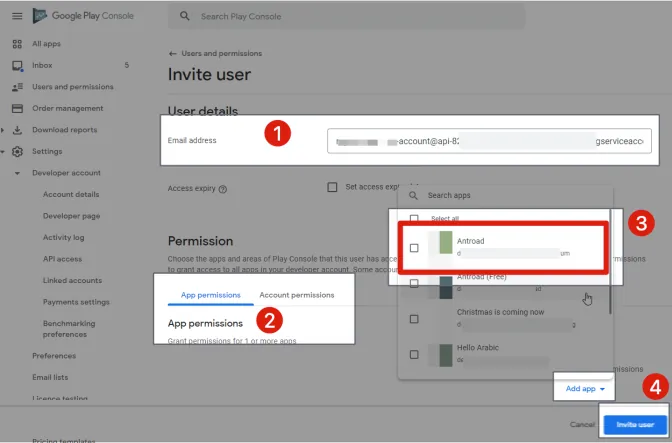
Enter the
Service Account Emailyou just noted in the Email address fieldApp permissions -> Add app
Add the target App to fetch reviews from
Click “Invite user” to complete the invitation without verification.
Get Google Play Console Developer ID & App ID & Package Name Information:
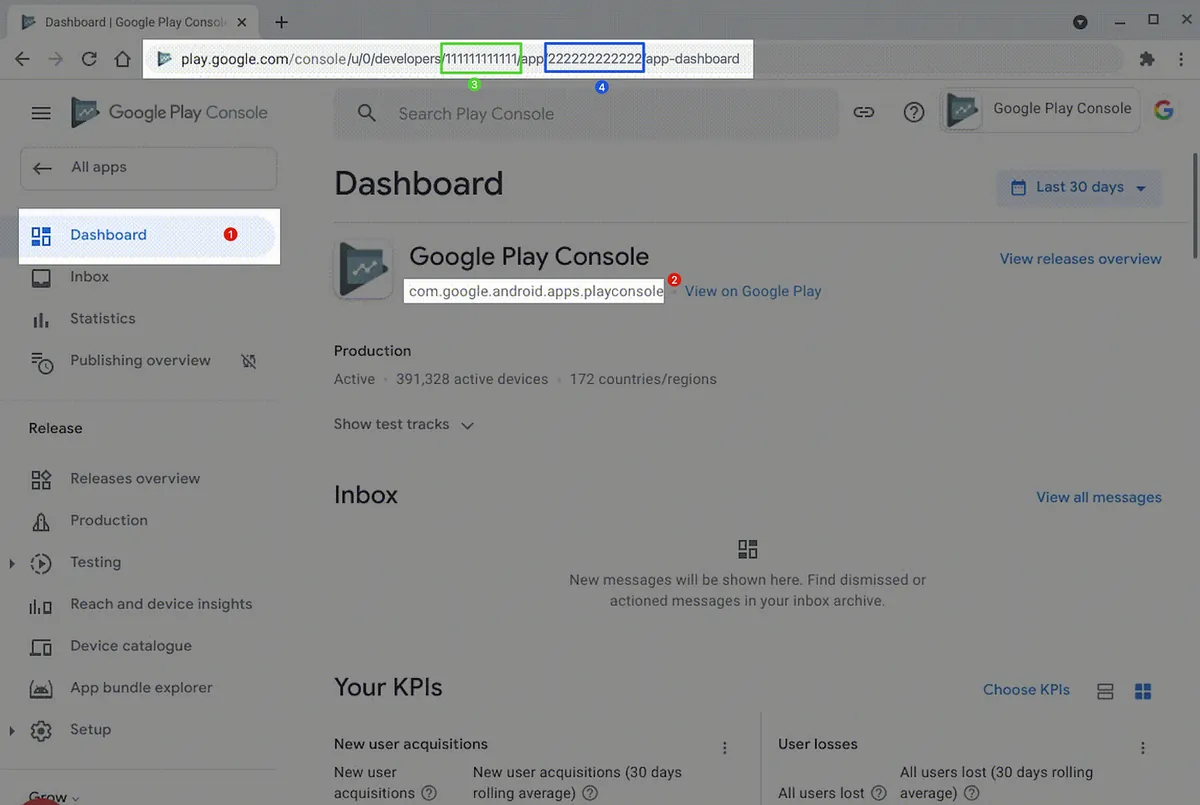
Click the target App to fetch reviews and enter the Dashboard
Note down the
Package Namefor later configuration
Copy the Dashboard URL and find from the URL:
Among them, /developers/
XXXis yourDeveloper ID. Note down this number for later configurationAmong them, /app/
XXXis yourApp ID, remember this App ID number for later setup
Credential setup completed.
Step 3. Github Action Deployment and Configuration File Setup
The exciting news is that I have packaged the complex Github Repo and Github Action setup into a Repo Template & Marketplace Github Action. You can complete the work by following these simple steps.
Go to: ZReviewTender-deploy-with-github-action :
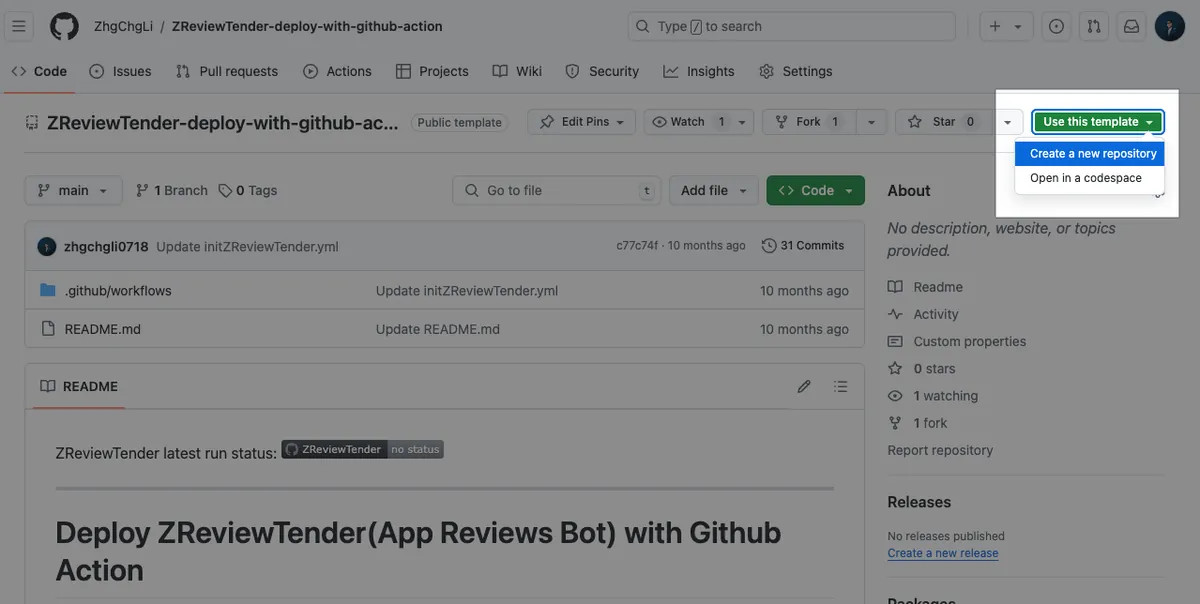
https://github.com/ZhgChgLi/ZReviewTender-deploy-with-github-action
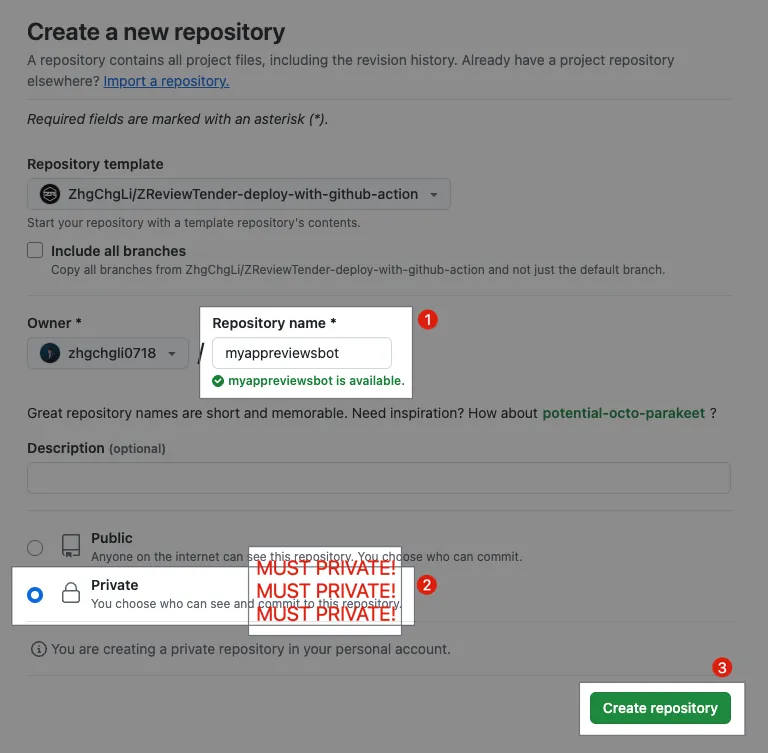
Repository name: Enter the desired Repo name
Private: Since the Repo will store access keys, be sure to set it as a Private Repo ⭐️⭐️⭐️
Private: Since the Repo will store access keys, be sure to set it as a Private Repo ⭐️⭐️⭐️
Private: Since the repo will store access keys, be sure to set it as a Private Repo ⭐️⭐️⭐️
Click “Create repository”
The author and contributors of ZReviewTender, ZhgChgLi, are not responsible for any losses caused by your use of ZReviewTender.
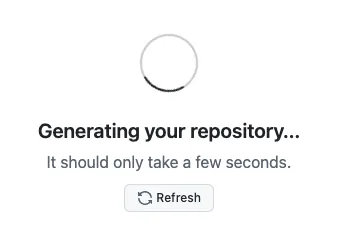
Waiting for Repository Creation:
Confirm again that the repository created is Private:
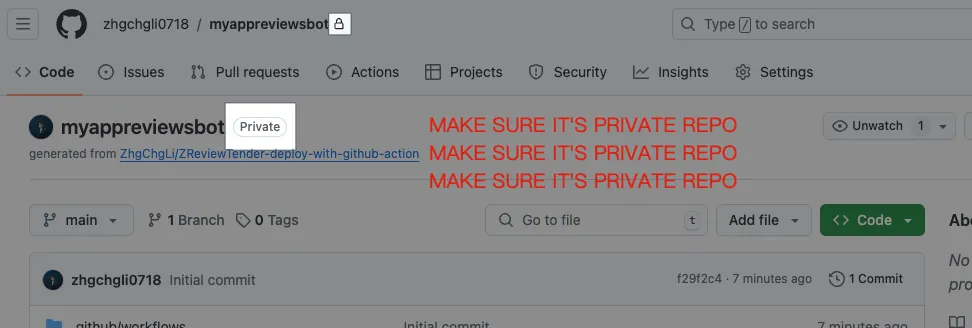
Private: Since the repo will store access keys, be sure to set it as a Private Repo ⭐️⭐️⭐️
Private: Since the repo will store access keys, be sure to set it as a Private Repo ⭐️⭐️⭐️
Private: Since the Repo will store access keys, be sure to set it as a Private Repo ⭐️⭐️⭐️
Enable Github Actions Permissions:
After creating the repo, due to Github security settings, you need to go to Repo Settings to allow Github Actions to run.
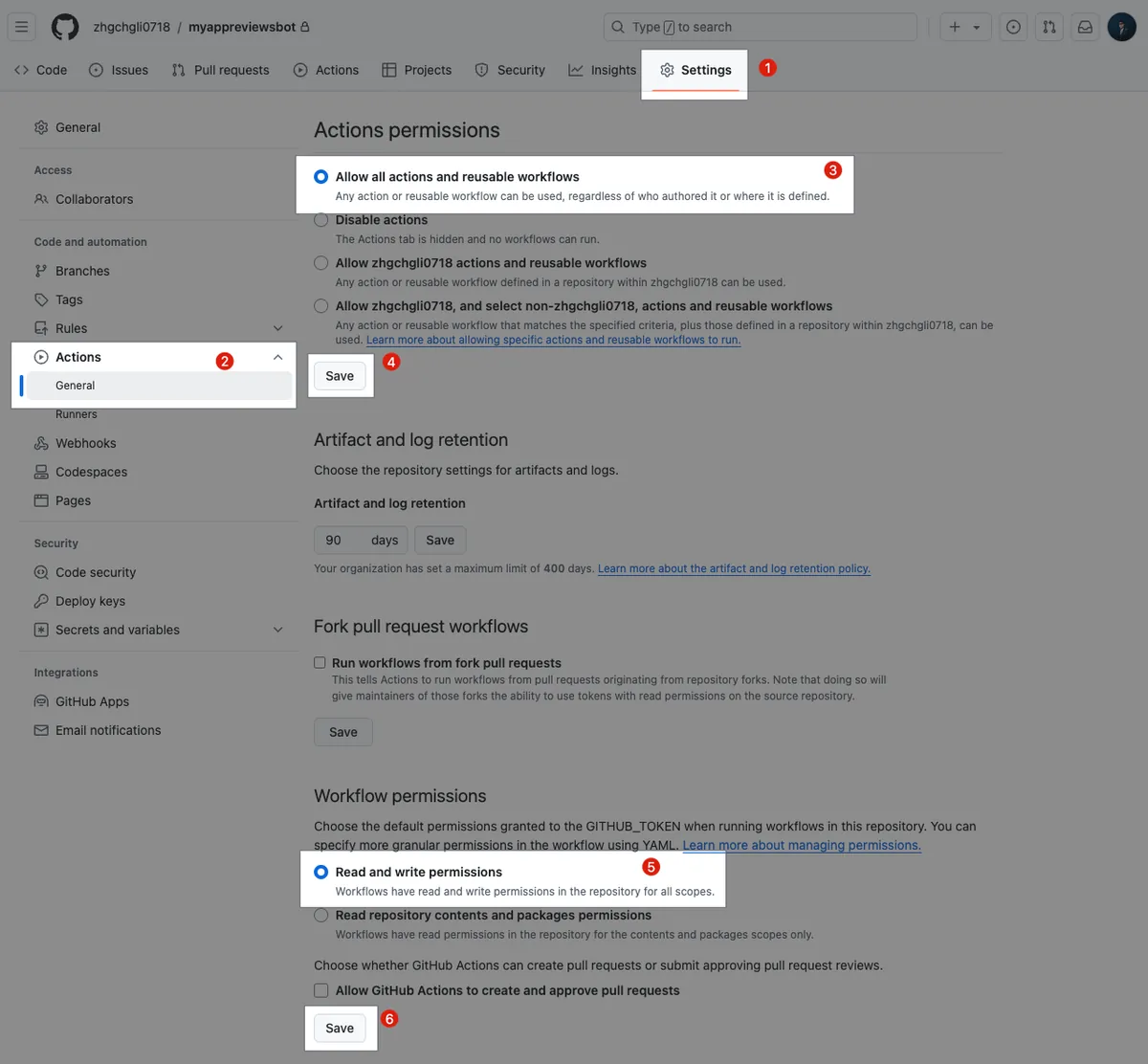
Repo -> Settings
Select “Actions” -> “General”
Set Actions permissions to “Allow all actions and reusable workflows”
Click “Save”
Set Workflow permissions to “Read repository contents and packages permissions”
First Run, Initialize ZReviewTender:
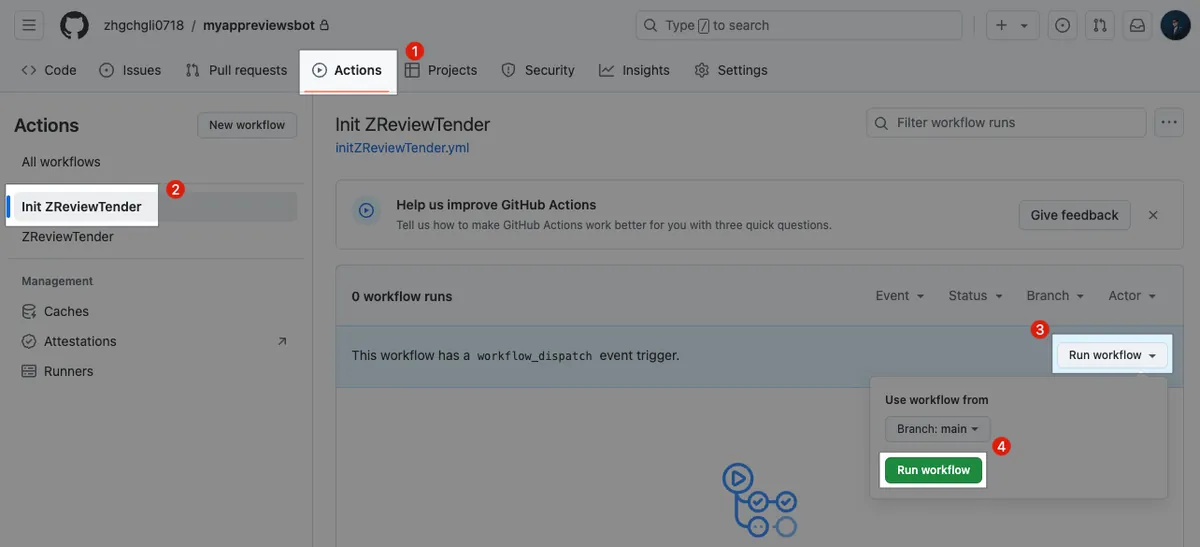
Repo -> Actions
Select “Init ZReviewTender”
Select “Run workflow”
Click “Run workflow”
Refresh the page
Wait for init ZReviewTender Action to complete:

If you encounter ❌ Error: please recheck whether the previously mentioned Github Actions permission settings are correct.
After successful initialization, two new directories will appear on the Repo homepage:
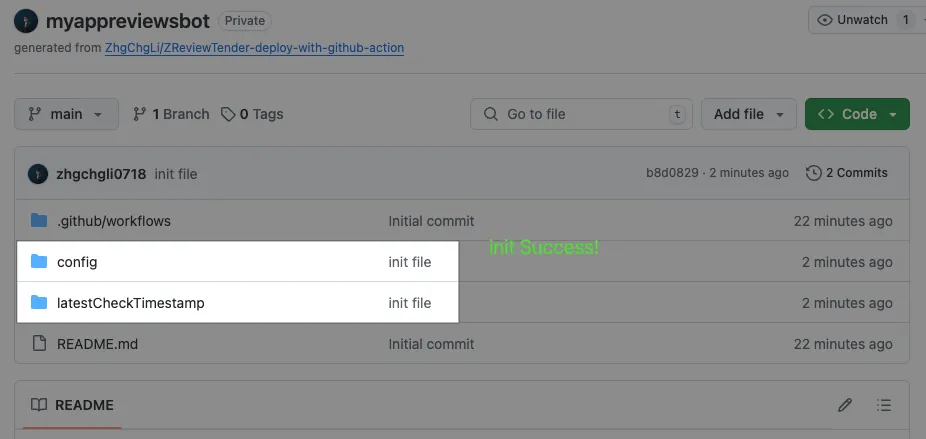
Certificate files required for upload:
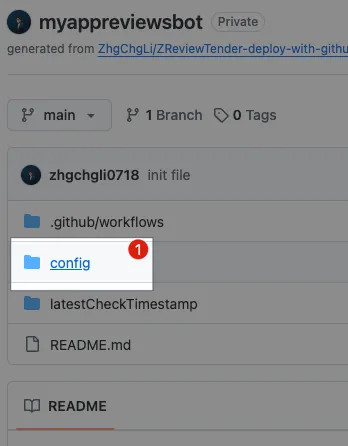
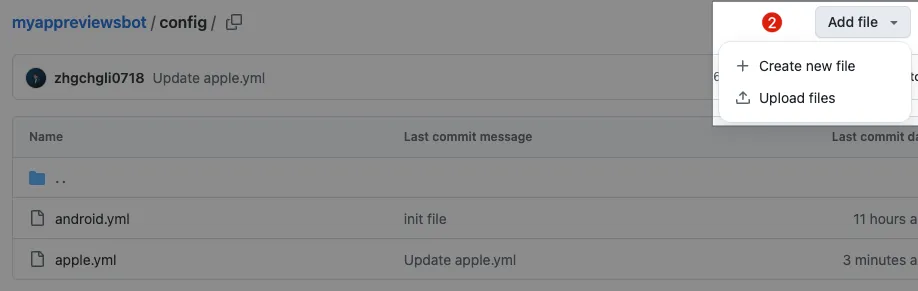
Enter the
/configdirectoryTop right corner “Add file” -> “Upload files”
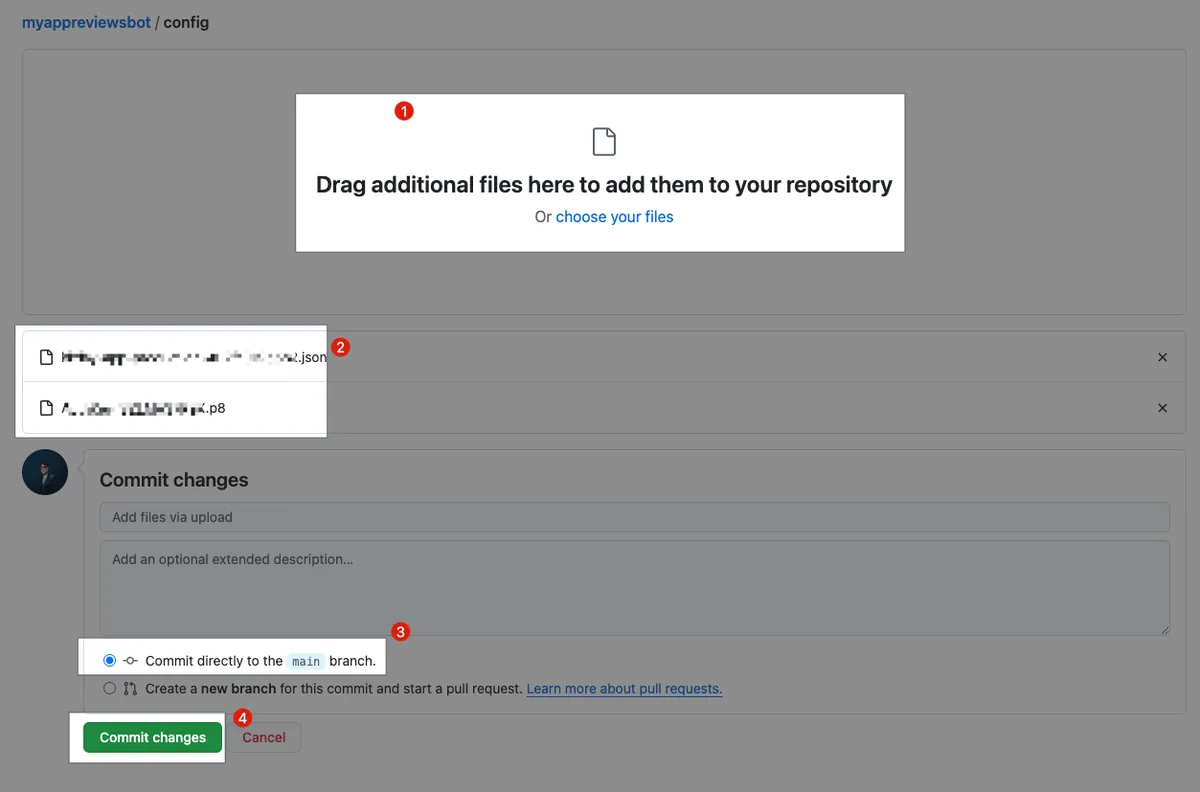
Upload the saved GCP Service Account
XXXX-XXXX.json(for Android) along with the App Store Connect savedAuthKey_XXXXXXXXXX.p8(for iOS).Wait for the upload to complete.
Select “Commit directly to the main branch.”
Click “Commit changes.”
Set up Apple (iOS):
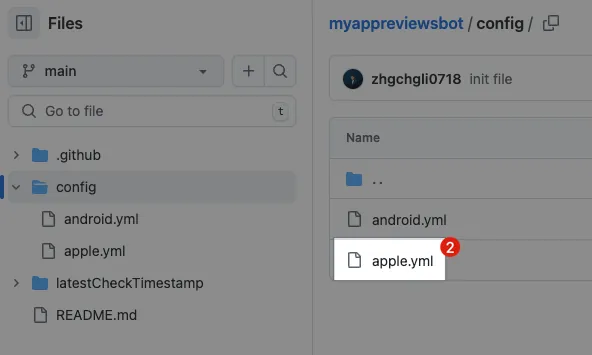
- Go to the
config/directory and click theapple.ymlfile
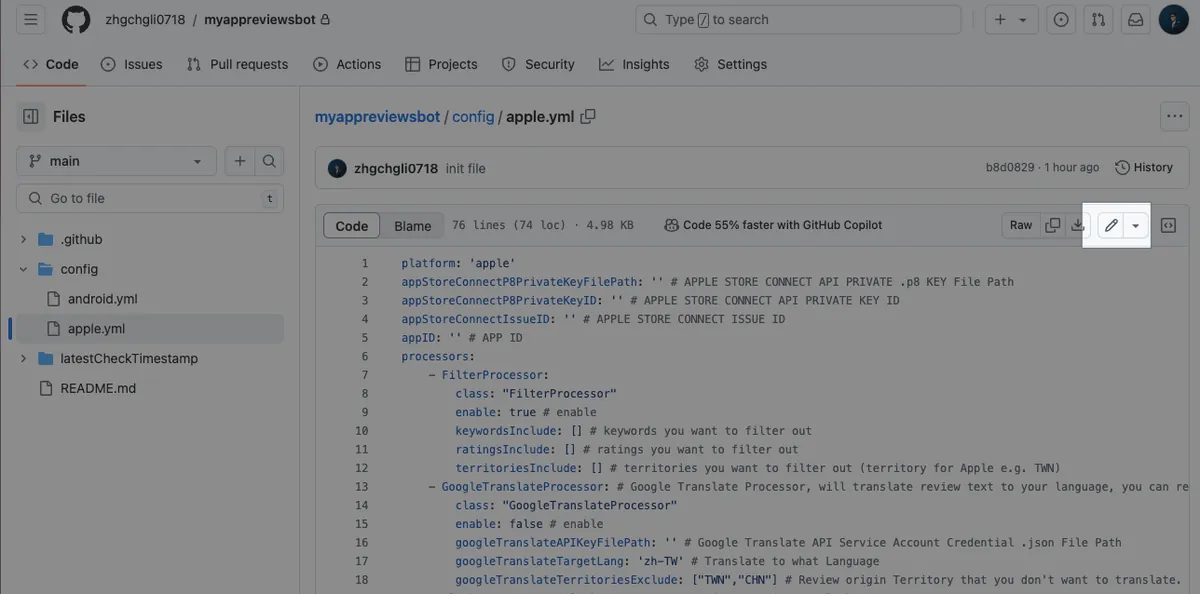
- Click the top right corner “🖊️ Edit”
Edit apple.yml, paste the following content, and fill in the information noted in the previous steps:
1
2
3
4
5
6
7
8
9
10
11
12
13
14
platform: 'apple'
appStoreConnectP8PrivateKeyFilePath: './config/AuthKey_XXXXXXXXXX.p8' # APPLE STORE CONNECT API PRIVATE .p8 KEY File Path
appStoreConnectP8PrivateKeyID: 'Private Key ID' # APPLE STORE CONNECT API PRIVATE KEY ID
appStoreConnectIssueID: 'Issuer ID' # APPLE STORE CONNECT ISSUE ID
appID: 'App ID' # APP ID
processors:
    - SlackProcessor: # Slack Processor, resend App Review to Slack.
        class: "SlackProcessor"
        enable: true # enable
        slackTimeZoneOffset: "+08:00" # Review Created Date TimeZone
        slackAttachmentGroupByNumber: "1" # 1~100, how many review messages in one Slack message.
        slackBotToken: "Slack App Bot User OAuth Token" # Slack Bot Token, send Slack messages through Slack Bot.
        slackBotTargetChannel: "Target Channel ID" # Slack Bot Token, send Slack messages through Slack Bot. (recommended, first priority)
        slackInCommingWebHookURL: "" # Slack Incoming WebHook URL, send Slack messages through Incoming WebHook, not recommended, deprecated.
appStoreConnectP8PrivateKeyFilePath:
Enter./config/AuthKey_XXXXXXXXXX.p8(Step 2. The savedAuthKey_XXXXXXXXXX.p8file name from App Store Connect)appStoreConnectP8PrivateKeyID: Step 2. ThePrivate Key IDnoted from App Store ConnectappStoreConnectIssueID: Step 2. TheIssuer IDrecorded from App Store ConnectappID: Step 2. The target App’sApp IDrecorded from App Store Connect for data retrievalslackBotToken: Enter theSlack App Bot User OAuth Tokennoted in Step 1.slackBotTargetChannel: Enter theChannel IDnoted in Step 1 for the destination channel
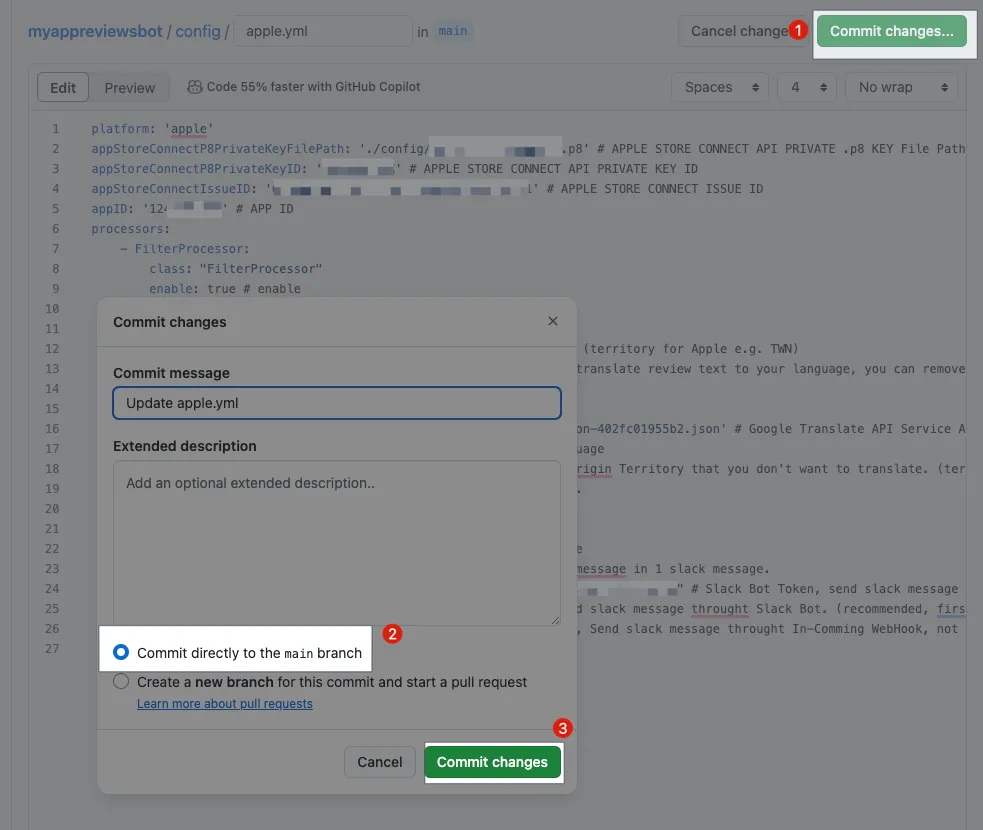
After editing, click “Commit changes…” at the top right corner.
Select “Commit directly to the main branch”
Click “Commit changes”
Setting up Android:
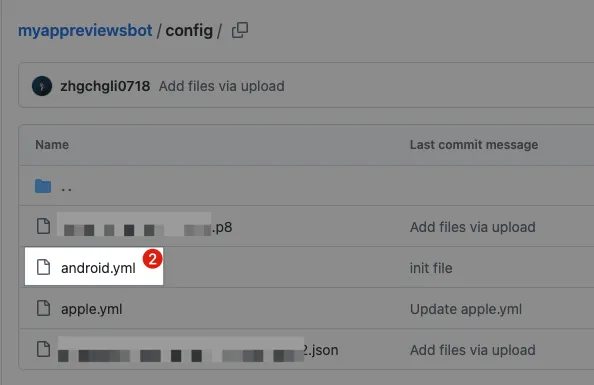
- Go to the
config/directory and click on theandroid.ymlfile
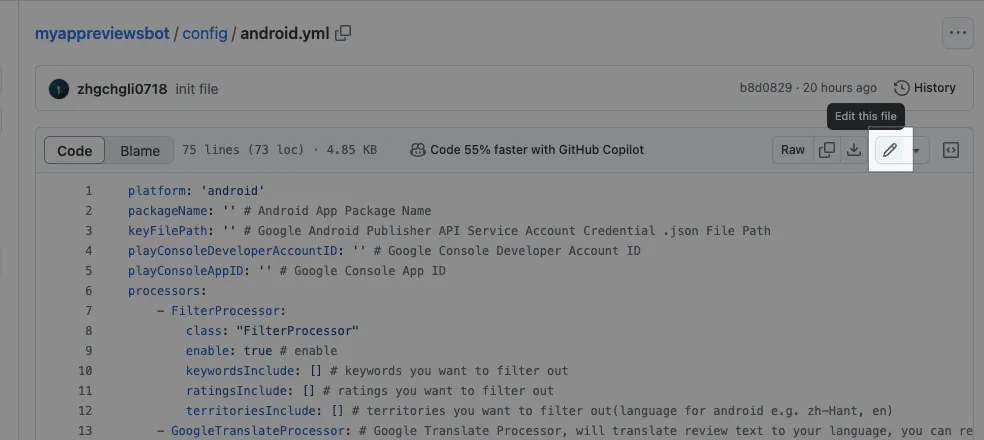
- Click the “🖊️ Edit” button at the top right corner
Edit android.yml, paste the following content, and fill in the information noted from the previous steps:
1
2
3
4
5
6
7
8
9
10
11
12
13
14
platform: 'android'
packageName: 'Package Name' # Android App Package Name
keyFilePath: './config/XXXX-XXXX.json' # Google Android Publisher API Service Account Credential .json File Path
playConsoleDeveloperAccountID: 'Developer ID' # Google Console Developer Account ID
playConsoleAppID: 'App ID' # Google Console App ID
processors:
- SlackProcessor: # Slack Processor, resend App Review to Slack.
        class: "SlackProcessor"
        enable: true # enable
        slackTimeZoneOffset: "+08:00" # Review Created Date TimeZone
        slackAttachmentGroupByNumber: "1" # 1~100, how many review messages in 1 slack message.
        slackBotToken: "Slack App Bot User OAuth Token" # Slack Bot Token, send slack message through Slack Bot.
        slackBotTargetChannel: "Target Channel ID" # Slack Bot Token, send slack message through Slack Bot. (recommended, first priority)
        slackInCommingWebHookURL: "" # Slack Incoming WebHook URL, send slack message through Incoming WebHook, not recommended, deprecated.
packageName: ThePackage Nameobtained from Step 2 in the Google Play Console backendkeyFilePath:
Enter./config/XXXX-XXXX.json(Step 2. TheXXXX-XXXX.jsonService Account key file name saved from GCP IAM)playConsoleDeveloperAccountID: Step 2. TheDeveloper IDobtained from the Google Play Console backendplayConsoleAppID: Step 2. TheApp IDobtained from the Google Play Console backendslackBotToken: Enter theSlack App Bot User OAuth Tokennoted in Step 1.slackBotTargetChannel: Enter theChannel IDnoted in Step 1 to send messages to
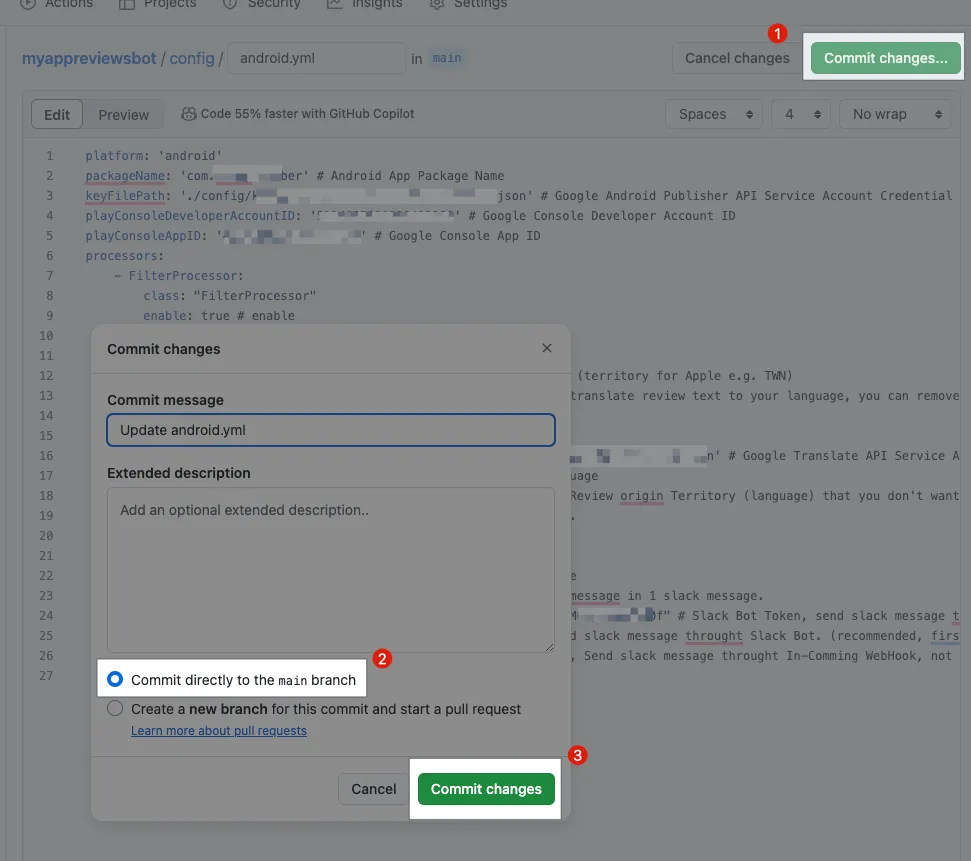
After editing, click “Commit changes…” at the top right corner.
Select “Commit directly to the main branch”
Click “Commit changes”
Setup Complete! 🚀🚀🚀🚀
Verify if the setup is successful:
We can run it manually once to confirm the settings are correct.
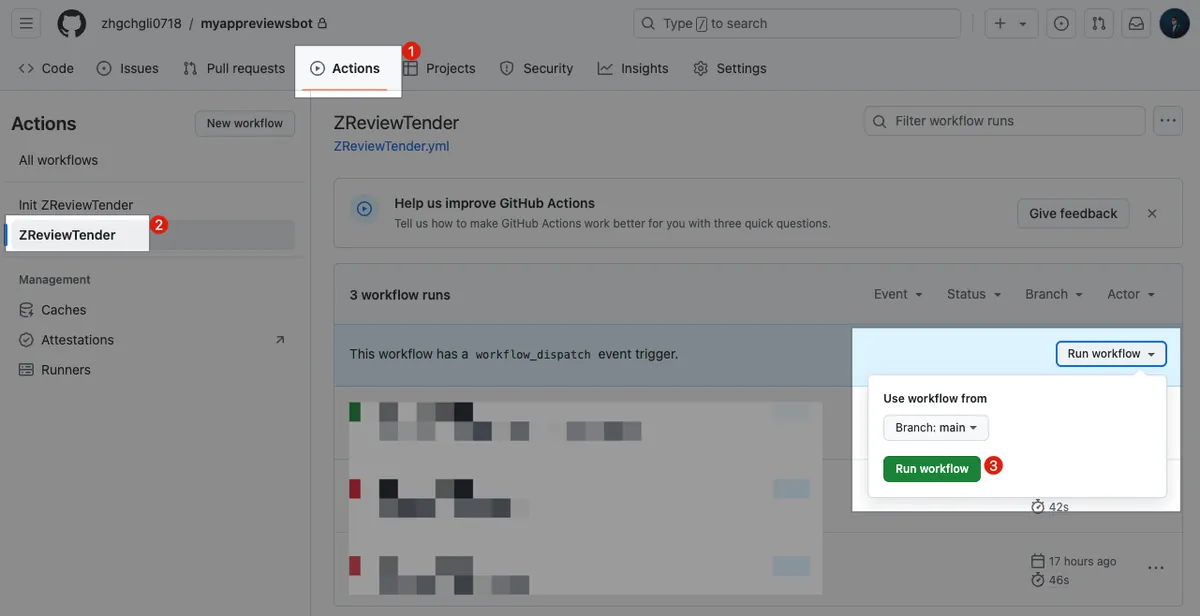
Repo -> Actions
Select “ZReviewTender”
Select “Run workflow”
Click “Run workflow”
Refresh the page
Wait for ReviewTender Action to complete:
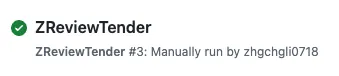
Verification Successful 🎉🎉🎉🎉
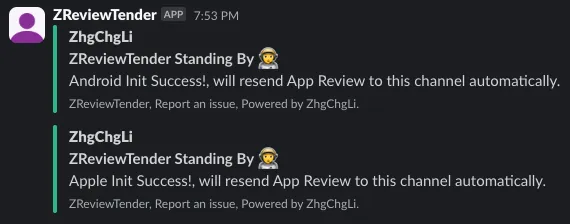
If you see ❌ Error or the Slack Channel does not receive the startup message: please recheck if the previous configuration files are correct.
Completed 🎉🎉🎉
Now you can rely on this free and reliable App review bot to stay updated on the latest user reviews at all times!
Buy me coffee ❤️❤️❤️
</contact>{:target=”_blank”}
If this project has helped you, please consider buying me a coffee. Thank you.
Other Settings
Add Filtering Functionality
Only forward reviews that meet the criteria.
1
2
3
4
5
6
    - FilterProcessor:
        class: "FilterProcessor"
        enable: true # enable
        keywordsInclude: [] # keywords you want to filter out
        ratingsInclude: [] # ratings you want to filter out
        territoriesInclude: [] # territories you want to filter out (territory for Apple e.g. TWN)
- You only need to add the
FilterProcessorsetting in theprocessorssection of/config/apple.ymlor/config/android.yml.
Adding Automatic Translation Feature
Automatically translate reviews in languages other than yours using Google Cloud Translation API (may incur costs).
Please first ensure that the GCP Project of the Service Account created in Step 2 has the “Cloud Translation API” enabled
The configurations for
apple.ymlandandroid.ymlhave some differences.
apple.yml:
1
2
3
4
5
6
    - GoogleTranslateProcessor: # Google Translate Processor, will translate review text to your language, you can remove whole block if you don't need it.
        class: "GoogleTranslateProcessor"
        enable: true # enable
        googleTranslateAPIKeyFilePath: './config/XXXX-XXXX.json' # Google Translate API Service Account Credential .json File Path
        googleTranslateTargetLang: 'zh-TW' # Translate to what Language
        googleTranslateTerritoriesExclude: ["TWN","CHN"] # Review origin Territory that you don't want to translate. (territory for Apple e.g. TWN)
./config/XXXX-XXXX.json(Step 2. TheXXXX-XXXX.jsonService Account key file name saved from GCP IAM)
android.yml:
1
2
3
4
5
6
    - GoogleTranslateProcessor: # Google Translate Processor, will translate review text to your language, you can remove whole block if you don't need it.
        class: "GoogleTranslateProcessor"
        enable: true # enable
        googleTranslateAPIKeyFilePath: './config/XXXX-XXXX.json' # Google Translate API Service Account Credential .json File Path
        googleTranslateTargetLang: 'zh-TW' # Translate to which language
        googleTranslateTerritoriesExclude: ["zh-Hant","zh-Hans"] # Review origin Territory (language) that you don't want to translate. (language for android e.g. zh-Hant, en)
./config/XXXX-XXXX.json(Step 2. TheXXXX-XXXX.jsonService Account key file name saved from GCP IAM)
Complete Example:
1
2
3
4
5
6
7
8
9
10
11
12
13
14
15
16
17
18
19
20
21
22
23
24
25
26
platform: 'android'
packageName: '' # Android App Package Name
keyFilePath: '' # Google Android Publisher API Service Account Credential .json File Path
playConsoleDeveloperAccountID: '' # Google Console Developer Account ID
playConsoleAppID: '' # Google Console App ID
processors:
    - FilterProcessor:
        class: "FilterProcessor"
        enable: true # enable
        keywordsInclude: [] # keywords you want to filter out
        ratingsInclude: [] # ratings you want to filter out
        territoriesInclude: [] # territories you want to filter out (territory for Apple e.g. TWN)
    - GoogleTranslateProcessor: # Google Translate Processor, will translate review text to your language, you can remove whole block if you don't need it.
        class: "GoogleTranslateProcessor"
        enable: true # enable
        googleTranslateAPIKeyFilePath: '' # Google Translate API Service Account Credential .json File Path
        googleTranslateTargetLang: 'zh-TW' # Translate to what language
        googleTranslateTerritoriesExclude: ["zh-Hant","zh-Hans"] # Review origin territory (language) that you don't want to translate. (language for android e.g. zh-Hant, en)
    - SlackProcessor: # Slack Processor, resend App Review to Slack.
        class: "SlackProcessor"
        enable: true # enable
        slackTimeZoneOffset: "+08:00" # Review created date timezone
        slackAttachmentGroupByNumber: "1" # 1~100, how many review messages in 1 slack message.
        slackBotToken: "" # Slack Bot Token, send slack message through Slack Bot.
        slackBotTargetChannel: "" # Slack Bot Token, send slack message through Slack Bot. (recommended, first priority)
        slackInCommingWebHookURL: "" # Slack Incoming WebHook URL, send slack message through Incoming WebHook, not recommended, deprecated.
After adjustments, save the .yml file following these steps:
After editing, click “Commit changes…” at the top right corner.
Select “Commit directly to the main branch”
Click “Commit changes”
Execution Parameter Settings
You can edit the ZReviewTender.yml file to set the execution parameters.
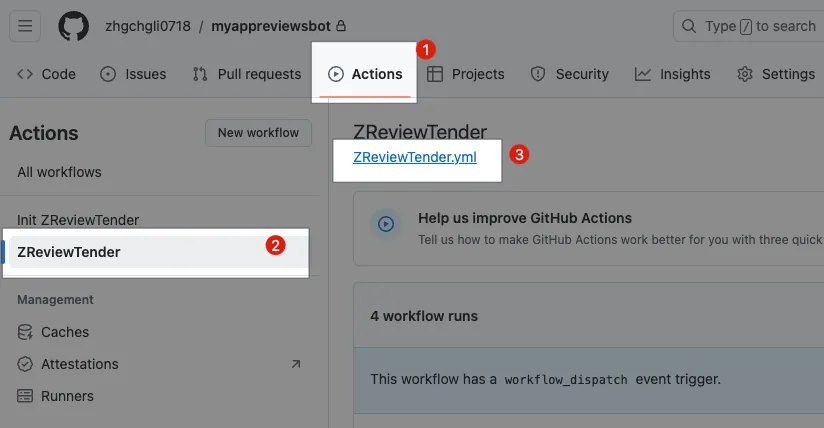
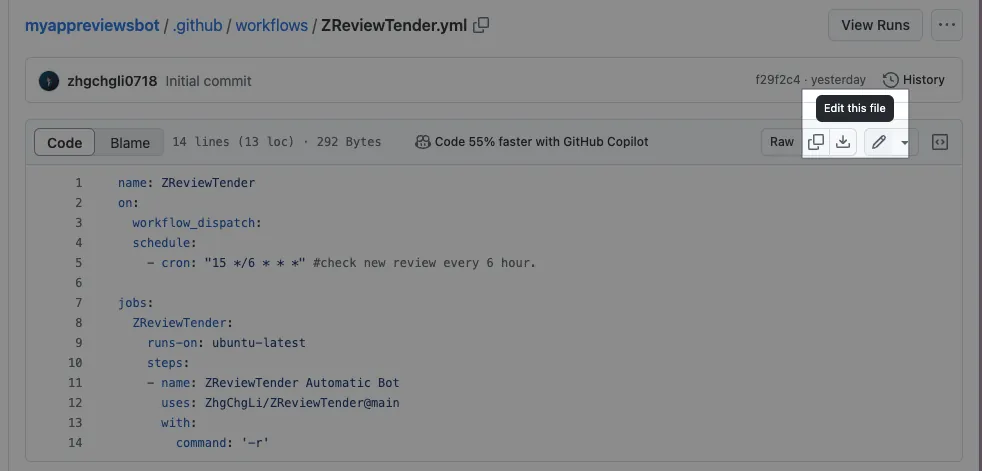
Repo -> Actions
Click “ZReviewTender”
Click on
ZReviewTender.ymlClick the top right corner “🖊️ Edit”
1
2
3
4
5
6
7
8
9
10
11
12
13
14
name: ZReviewTender
on:
  workflow_dispatch:
  schedule:
    - cron: "15 */6 * * *" # check new review every 6 hours.

jobs:
  ZReviewTender:
    runs-on: ubuntu-latest
    steps:
    - name: ZReviewTender Automatic Bot
      uses: ZhgChgLi/ZReviewTender@main
      with:
        command: '-r'
Adjust Check Frequency (How Often to Crawl and Forward New Reviews?)
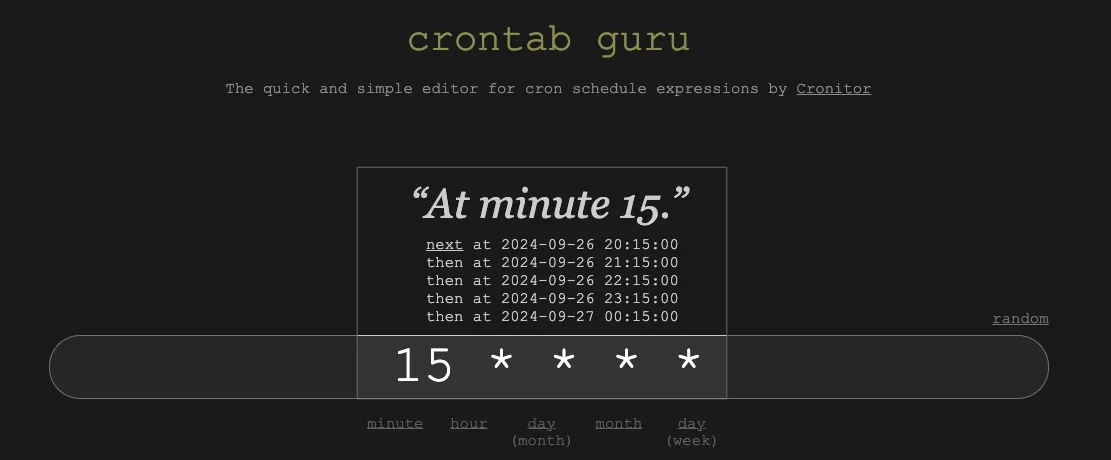
Adjust the settings in cron: "15 */6 * * *".
Parameters use Crontab notation. You can use the following website to generate your desired settings:
Adjust Execution Script
Adjust the setting value in command: "-r".
-r: Run both Android and Apple (iOS) review checks simultaneously-a: Run Apple (iOS) review check only-g: Only run Android review check
Adjustment Completed:
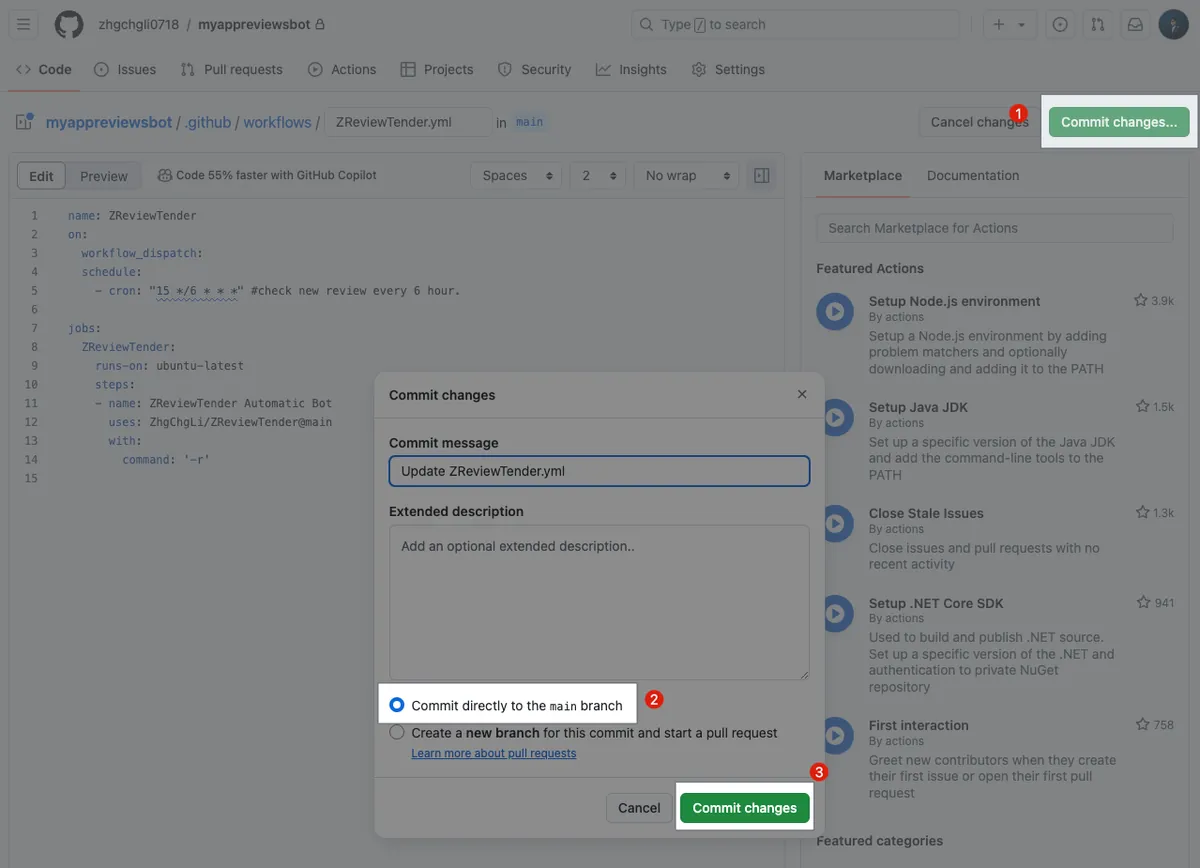
After editing, click “Commit changes…” at the top right corner
Select “Commit directly to the main branch”
Click “Commit changes”
Temporarily Pause Checking
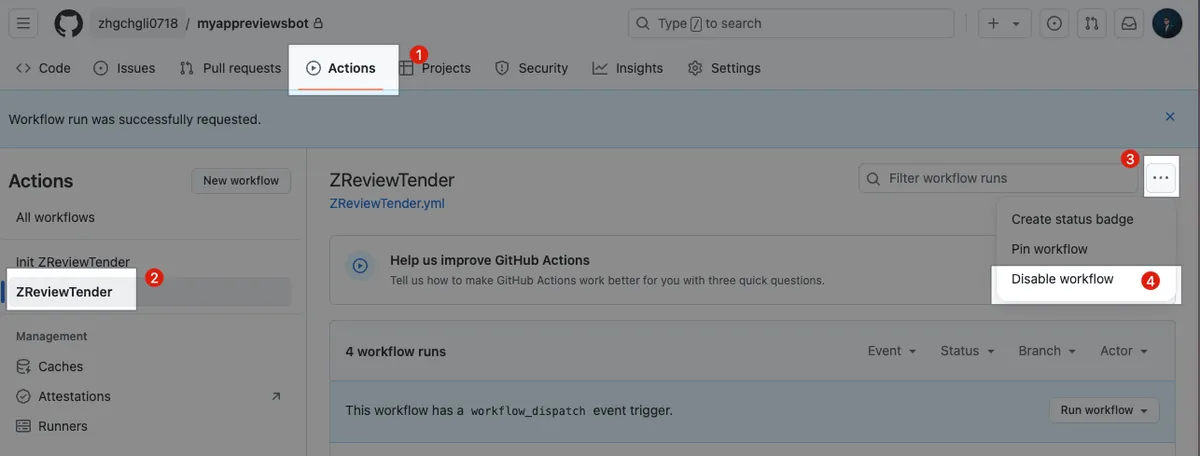
Repo -> Actions
Select “ZReviewTender”
Click the “…” on the right side
Select “Disable workflow”
Issue Reporting and Feature Suggestions
If you have any feature suggestions, questions, or bugs, please create an Issue in the above Github Repo. Thank you.
Advanced Usage and Development Story
ZReviewTender — Free and Open-Source App Reviews Monitoring Bot
App Store Connect API Now Supports Reading and Managing Customer Reviews
If you have any questions or feedback, feel free to contact me .
This post was originally published on Medium (View original post), and automatically converted and synced by ZMediumToMarkdown.